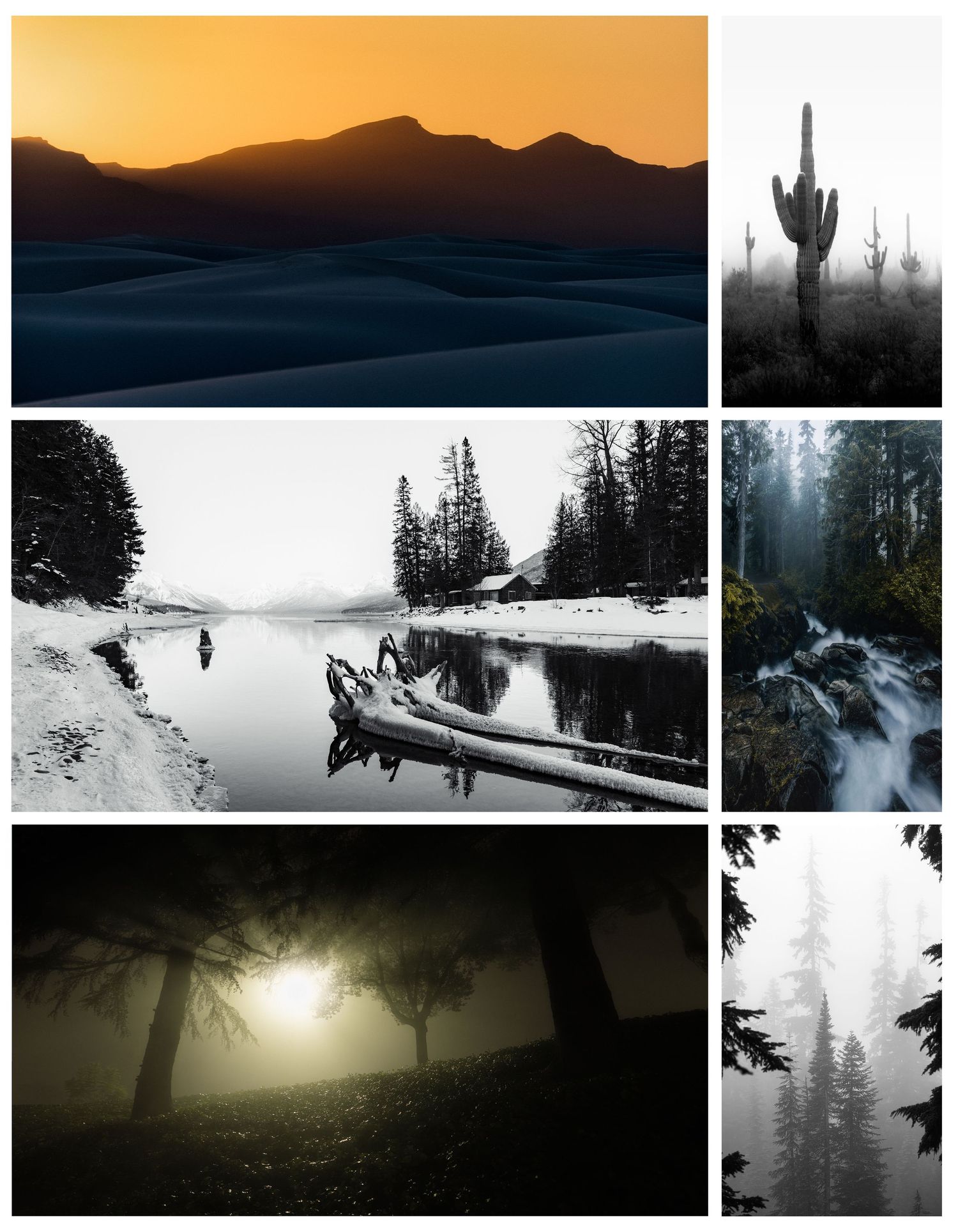
IT WAS ALWAYS THERE
On recognition, obscurity, and the social life of the natural world
By Adam Carity
A landscape is easy to name.
Tree. Cactus. Water. Mountain. Sand. Fog. Light.
Names are useful. They help us understand the world, organize what we encounter, and communicate what we see. But familiarity has an interesting consequence. Once something has been identified, there is a tendency to believe it has also been seen.
We recognize a forest without considering the lives unfolding within it. We see a cactus without wondering what it has endured. We follow a stream without thinking about the relationship between the water and the land through which it travels.
We recognize the individual elements, but how often do we stop to notice what is happening between them?
It Was Always There began with that question.
This collection of six photographs is an exploration of recognition. Not simply recognizing what something is, but recognizing the character, connections, and life that become apparent when we allow ourselves to look differently.
It is also an exploration of obscurity.
Fog removes distance. Darkness conceals surroundings. Snow simplifies a landscape. Fading light changes familiar shapes into unfamiliar forms.
Ordinarily, we might consider these conditions obstacles to seeing. But what if they offer an opportunity?
When nature becomes less literal, we become more perceptive.
Without the distraction of everything surrounding a subject, we begin to notice its presence. Its posture. Its relationship to what remains visible.
Sometimes, what disappears from a photograph is precisely what allows something else to emerge.
A Different Kind of Landscape
Nature is often presented as scenery. Something beautiful to observe, photograph, or experience.
But the natural world is not a collection of isolated objects arranged for our appreciation.
It is alive with interaction.
Trees compete for sunlight while participating in the ecosystems that sustain them. Water shapes the land while the land determines its course. Animals move through environments that provide shelter, nourishment, and opportunities for survival. Every living thing exists within a larger network of relationships.
There is cooperation, competition, dependence, resistance, and change.
And there is something else: the character we begin to recognize when we pay attention.
A gathering of trees can resemble a family. A solitary cactus can appear to stand watch. Light filtering through fog can suggest an exchange that feels almost private.
These interpretations are human, of course. But perhaps that is part of what makes photography interesting.
A photograph does not have to establish that nature experiences the world as we do. It can invite us to recognize something familiar in a world we have become accustomed to treating as separate from ourselves.
What if we are surrounded by conversations we simply do not know how to hear?
And what might we discover if we pause long enough to notice?
Six Encounters
WHEN THE DAY TURNS IN
At White Sands, the final sunlight reaches across the desert as the dunes surrender to shadow.
The landscape becomes an arrangement of contrasting worlds. Warm light settles along the horizon while the sand takes on the deep blue tones of approaching night.
There is a transition taking place, a quiet exchange between what is leaving and what is arriving.
The day does not end everywhere at once. It retreats gradually, revealing another character in the landscape.
For a brief moment, we witness both.
DESERT SENTINELS
In the fog, the desert becomes a place of silhouettes.
A saguaro stands prominently in the foreground while others emerge at varying distances behind it. Their individual forms remain recognizable, but the obscured landscape changes how we perceive their presence.
They begin to resemble sentinels.
Standing. Watching. Enduring.
The fog removes the familiar desert surroundings, allowing their posture and apparent companionship to become the subject.
They were always standing there.
What changed was the way I saw them.
IN GOOD COMPANY
A snow-covered landscape surrounds a quiet mountain lake. Trees gather along its edges, and a small dwelling occupies its place among them.
There is a particular kind of stillness that arrives with snowfall. Familiar distinctions soften. The landscape becomes quieter, its individual elements appearing to settle into one another's company.
The dwelling introduces a human presence without dominating the scene.
Rather than suggesting that humanity stands apart from nature, the photograph considers the possibility of belonging within it.
We are not necessarily outsiders observing the natural world.
Sometimes, we are simply part of the gathering.
THE AGREEMENT
Water moves through a forest, finding its way around rocks and through the terrain.
At first, the relationship seems straightforward. The water follows the path available to it.
But the exchange is more complicated.
The land determines where the water can travel. The water, in turn, gradually changes the land. It moves sediment, shapes channels, nourishes vegetation, and influences the environment through which it passes.
Neither remains entirely unchanged.
What appears to be a stream moving through a forest is also an ongoing relationship between them.
An agreement, not in the human sense of a conscious negotiation, but in the observable sense of continuous exchange and mutual influence.
Each shapes the other.
BETWEEN US
Light emerges through the darkness, revealing only fragments of a landscape concealed by fog.
The photograph offers few answers about what lies beyond the visible scene. Trees emerge from shadow, their forms appearing and disappearing within the illuminated mist.
Light makes the fog visible. The fog, in turn, gives the light a presence that would otherwise be difficult to see.
Neither produces quite the same experience without the other.
What interests me is the space created by that interaction.
The photograph becomes less about identifying a location and more about recognizing an encounter.
There is something intimate about seeing only what the light allows us to see, while knowing that an entire world continues beyond it.
Something remains between us and the unseen.
FAMILY GATHERING
A group of trees emerges through layers of fog.
Some stand prominently. Others recede into the distance. Branches overlap, individual forms intersect, and the forest appears to gather around itself.
The arrangement suggests something familiar.
A family.
There is no need to claim that trees possess human relationships to recognize the resemblance. The photograph invites us to notice the way individual lives exist together, occupying different positions within a shared environment.
The fog creates separation while simultaneously emphasizing connection.
Some trees are clearly visible. Others are barely distinguishable.
Yet they remain part of the same gathering.
It is a simple observation, but one that changes the experience of looking at a forest.
Instead of seeing trees, we begin to see company.
The Act of Recognition
Photography has always interested me because of its ability to change how we perceive something that already exists.
The camera does not need to invent a subject. Sometimes its greatest contribution is removing enough information for us to reconsider what remains.
That is particularly true of the natural world.
We are surrounded by extraordinary interactions that have become ordinary through repetition. We recognize the familiar shapes of our environment so quickly that we rarely question what else there might be to notice.
Obscurity interrupts that habit.
When the landscape refuses to reveal everything immediately, we have an opportunity to become more attentive.
We begin to look at posture instead of identity. Proximity instead of individual objects. Interaction instead of scenery.
We begin to notice life.
Not necessarily in the literal sense of attributing consciousness to every element of a landscape, but in the broader sense of recognizing a world that is active, interconnected, and continually changing.
A world in which we also belong.
That is what connects these six photographs.
They are not intended to provide definitive interpretations of nature. Their titles offer perspectives, not conclusions.
A cactus might become a sentinel. Trees might become a family. Water and forest might arrive at an agreement.
Another viewer might recognize something entirely different.
That possibility is important.
The purpose is not to tell someone precisely what to see. It is to encourage the kind of attention that allows discoveries to happen.
Perhaps the most meaningful photographs do not introduce us to something new.
Perhaps they change our relationship with something we have known all along.
The photographs offer no final vocabulary for that world. They simply suggest that before we arrived, before the camera arrived, before anyone thought to give these relationships names, they were already taking place.
It was always there.